Why acne scars are so hard to treat
Patients who come to me about acne scarring have usually tried a lot already. Creams, needling, a single laser session somewhere, sometimes filler. They often say the same thing: it helped a little, or it helped for a while, but the scars are still there in certain lights, and they are tired of chasing them.
There is a reason for that, and it is worth understanding before you spend money on any single treatment. A depressed acne scar is not simply a dent in the surface. It has two separate problems happening at once, at two different depths, and a treatment that fixes one will always leave the other behind. Once you understand the two, the right approach becomes much clearer, and so does why a combination of treatments works when one alone does not.
What is actually happening in an acne scar?
When a spot becomes deeply inflamed, the inflammation damages the skin below the surface. As the body heals, it lays down repair tissue, but that repair is imperfect in two ways.
First, the skin loses volume in that spot. The dermis, the deeper structural layer, becomes thinned and weakened where the collagen was destroyed. This is why the area sits lower than the skin around it. It is a genuine loss of tissue, not just a surface mark.
Second, and this is the part most people never hear about, the healing tissue forms tethers. Bands of fibrous scar tissue anchor the base of the scar down to the deeper layers, like a button pulling down a piece of upholstery. These tethers actively hold the scar below the surface and stop it lifting.
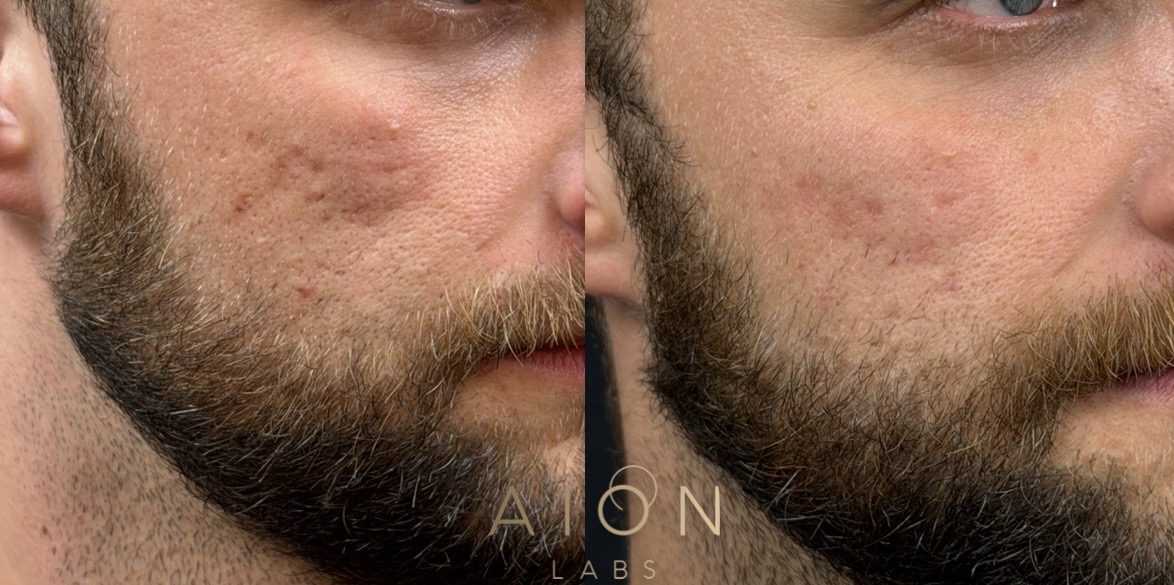
So a depressed scar has an internal problem and an external problem. Internally, it is tethered down and short of collagen. Externally, it often has sharp edges, and those edges are what create the hard shadow that makes a scar so visible. A scar with a soft, sloping edge catches far less light than one with a sharp rim. Much of what you see when you look at a scar in unforgiving light is shadow, not depth.
Why a single treatment falls short
Once you see the scar as two problems, the limitation of any single treatment becomes obvious.
Laser alone works on the surface, but it cannot release a deep tether holding the base down. Subcision alone releases the tether, but it does not carve down a sharp edge or resurface the skin. Filler alone lifts the floor for a while but does nothing about the tether or the collagen, and it fades. Each of these does one job. A depressed scar needs several jobs done.
This is why I approach moderate to severe scarring as a combination, with each step addressing a different part of the problem.
The combination approach, step by step
1. Subcision, to release the tethers
Subcision releases the fibrous bands anchoring the scar down. A fine instrument is passed under the scar to break the tethers, which frees the base and allows it to lift toward the surface. This treats the internal cause that surface treatments cannot reach. On its own it is one of the most effective things we can do for a tethered scar, and it is the logical first step, because there is little point resurfacing a scar that is still being pulled down from below.
2. Biostimulators, to rebuild lost collagen
Releasing the tether creates space, and that space needs to be filled with the patient's own collagen rather than left empty or propped up with temporary filler. This is where a biostimulator such as Radiesse comes in. Placed correctly, it does two things: it provides some immediate support to the released base, and it stimulates the skin to produce new collagen in the thinned, weakened area over the following months. The aim is to rebuild the tissue that was lost, so the correction comes from the skin itself and lasts.
3. Ablative laser, to soften the edges
With the base released and rebuilding, attention turns to the external problem: the sharp edges casting shadow. Fully ablative laser is used to carve down those sharp rims, turning a hard, shadow-catching edge into a softer slope that blends with the skin around it. This step changes how light falls across the scar, which is a large part of how visible it is, and it is the part that surface-only approaches try and fail to do without first addressing the base.
4. Fractional laser, to resurface overall
Finally, fractional laser treats the whole area rather than the individual scar. It creates controlled microscopic zones of injury across the skin, prompting a broad collagen-building response that improves overall texture, tone and quality. This ties the treated scars back into the surrounding skin and lifts the result of everything done beneath it.
The sequence matters. Release the base, rebuild the volume, soften the edges, then resurface the whole. Done in that order, each step supports the next.
Your skin tone changes which lasers are safe
This is a part of acne scar treatment that is too often ignored, and getting it wrong can leave someone worse off than they started, with pigmentation problems on top of the original scarring.
The risk is post-inflammatory hyperpigmentation, where treated skin heals darker. This risk is higher in richer, darker skin tones, and it means the treatment plan has to be chosen around the individual's skin, not applied identically to everyone.
The good news is that the two treatments doing the deepest structural work are safe across all skin tones. Subcision is safe in every skin type, because it works mechanically beneath the surface rather than by heating the skin. Erbium laser is also safe in all skin tones, which makes it a valuable resurfacing tool for darker skin where other lasers carry more risk.
CO2 laser, which is a powerful resurfacing tool, is a different matter. In my practice I consider fully ablative CO2 appropriate for lighter skin types, broadly Fitzpatrick 1 to 3, and I am cautious about extending it further because of the pigmentation risk in darker skin. For patients with richer skin tones, a plan built around subcision, biostimulators and erbium can achieve a great deal without taking that risk. The point of a proper consultation is to build the plan around your skin, so you get the result without the complication.
What results are realistic?
Honesty matters here, because acne scarring is a field full of overpromising. The goal is significant improvement, not perfect skin. Scars that have been there for years can be softened, lifted and blended so they no longer dominate the face or catch the light the way they did, and for most people that is a genuinely life-changing difference. But it takes a series of sessions over months, because collagen rebuilding is a slow biological process that cannot be rushed. Anyone promising to erase deep scarring in a single session is not being straight with you.
Frequently asked questions
What is the best treatment for deep acne scars?
Deep depressed scars usually need a combination rather than one treatment: subcision to release the tethered base, a biostimulator to rebuild collagen, and laser to soften the edges and resurface. Each addresses a different part of the scar.
What is subcision for acne scars?
Subcision is a minor procedure that passes a fine instrument beneath a scar to break the fibrous bands anchoring it down. Releasing these tethers allows the scar base to lift toward the surface. It is safe in all skin tones.
Is laser acne scar treatment safe for darker skin?
It depends on the laser. Subcision and erbium laser are safe across all skin tones. Fully ablative CO2 laser carries a higher risk of pigmentation problems in darker skin, so the plan should be chosen around your skin type.
How many sessions does acne scar treatment take?
Moderate to severe scarring typically needs a series of sessions over several months, because rebuilding collagen is a gradual process. The exact number depends on the depth and type of scarring, assessed at consultation.
Can acne scars be removed completely?
Realistically the goal is major improvement rather than complete removal. Scars can be lifted, softened and blended so they no longer catch the light or dominate the face, which for most patients is a substantial change.
Book a consultation
Acne scarring responds best to a plan built around your specific scars and your skin type. Consultations are available at Aion Labs in London.