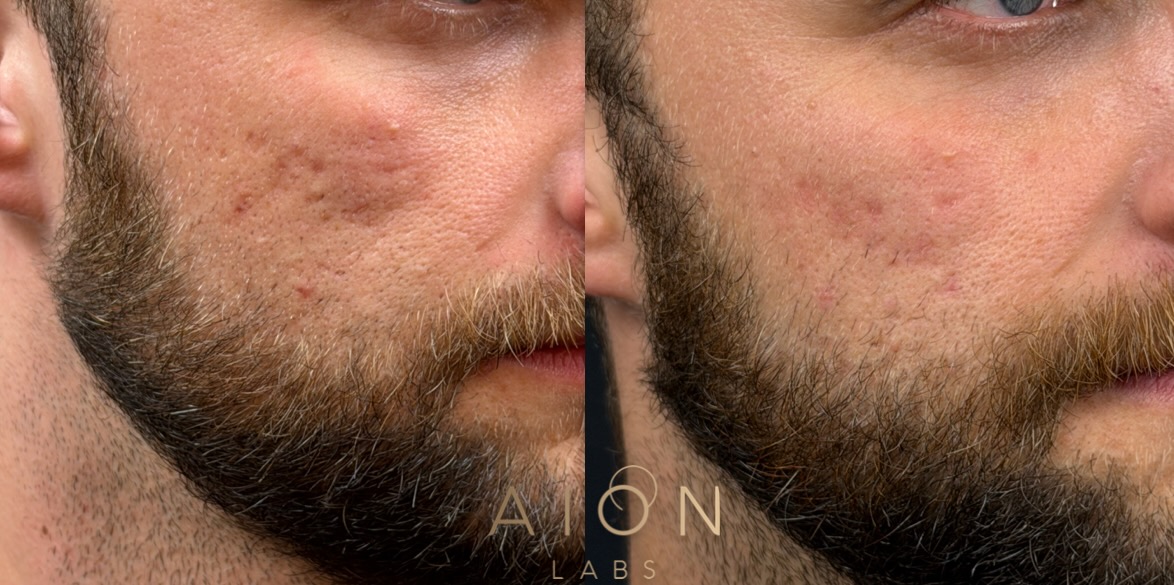
Subcision is a treatment for acne scars that are tethered to the tissue underneath, which pulls the skin down and creates a rolling or uneven surface. At Aion Labs, Dr Rob Humphries combines every subcision with Radiesse (an injectable biostimulator), placed during the same procedure, to restore lost volume and help keep the scars released.
At a glance
Subcision works best on scars that soften when the skin is stretched. Ice pick scars and very shallow scars usually respond better to other treatments, such as laser resurfacing or TCA Cross chemical peels.
Many acne scars are held down by bands of scar tissue that connect the skin to the deeper layers. Subcision uses a fine needle or blunt cannula, passed under the skin, to release these bands so the skin can lift back up.
At Aion Labs, Radiesse is placed into the released area straight away, during the same procedure. It restores volume under scars where tissue has been lost, and acts as a spacer to reduce the chance of the bands reattaching as the skin heals. Radiesse is a gel made of calcium hydroxylapatite microspheres, and it also stimulates your own collagen over the following months.
Most patients have more than one type of scar. For rolling or boxcar acne scarring, Dr Humphries almost always recommends at least one session of subcision alongside a course of three ablative laser treatments. Subcision releases and lifts the scars from below, and the laser resurfaces the skin surface.
Consultation. Dr Humphries takes a full medical history and examines your scars in different lighting to work out which types you have. He will take photos and agree a plan and cost with you.
Treatment. Local anaesthetic is used to numb the area. The scar bands are released and Radiesse is placed into the treated area straight away. Each session usually takes 30 minutes.
Aftercare. Expect bruising and swelling, which can be noticeable for 1 week. Avoid strenuous exercise, alcohol and make-up for 24-48 hours.
Bruising and swelling are expected and are often more noticeable than after other injectable treatments. Small lumps can be felt under the skin for a few weeks while the area heals.
Radiesse cannot be dissolved in the way hyaluronic acid filler can, although the product is gradually broken down by the body. Rarely, it can cause firm nodules or, as with any injectable, block a blood vessel. Dr Humphries will talk through these risks with you before treatment.
Most patients have a course of 3 sessions, 6 weeks apart. Where subcision is combined with laser, at least one session is usually recommended alongside a course of three laser treatments.
The area is numbed with local anaesthetic, so most patients feel pressure rather than pain. It can feel sore for a few days afterwards.
Bruising and swelling usually last 1 week. Most patients plan treatment so they do not have important events in the following fortnight.
Radiesse is placed into the released area during the procedure. It adds volume under scars where tissue has been lost, reduces the chance of the scar bands reattaching, and stimulates collagen over the following months.
Subcision can significantly improve rolling scars, but most patients see an improvement rather than complete removal. Dr Humphries will give you a realistic idea of what to expect at your consultation.
Yes, and for rolling or boxcar scars this is what Dr Humphries usually recommends. A typical plan includes at least one session of subcision alongside three ablative laser treatments.
Dr Rob Humphries MB BChir (Cantab), BDS, MRCS is the founder of Aion Labs. He studied medicine at Cambridge and dentistry at King’s College London, trained in oral and maxillofacial surgery, and is an award-winning international Endolift trainer. [Link to /team/ page]